Integrity verification of medical imagery using multi-level wavelet/cosine features and a 512-bit key seeded 4D hyperchaotic map
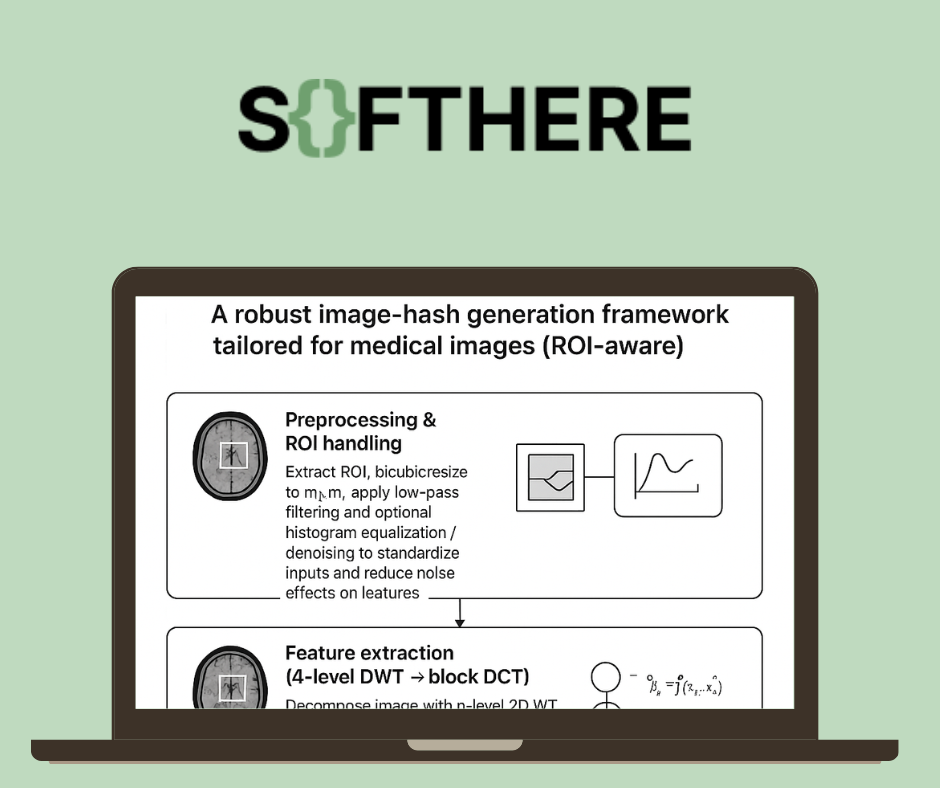
A robust image-hash generation framework tailored for medical images (ROI-aware) that fuses multi-resolution frequency-domain feature extraction (DWT followed by block-wise DCT) with a 4D hyperchaotic system to produce high-entropy hash values (e.g., 512 bits). Core technical elements:
Preprocessing & ROI handling
Extract ROI, bicubic resize to m×m, apply low-pass filtering and optional histogram equalization / denoising to standardize inputs and reduce noise effects on features.
Feature extraction (4-level DWT → block DCT)
Decompose image with n-level 2D DWT, take LLₙ band, split into k×k blocks, compute DCT per block and gather DC coefficients into feature vector Vdc.
Hyperchaotic 4D map seeding
Use Vdc components and expanded parameters (β1…β4) derived from a 512-bit user key to initialize the hyperchaotic system (x1..x4). The system’s sensitivity provides strong diffusion of small changes into the generated sequences.
Key expansion & dynamic perturbation
Convert 512-bit key to hexadecimal chunks to compute β parameters and perturbation values (Δα, Δβ), enabling dynamic updates of initial conditions and increased resistance to side-channel/transient exploitation.
Transient elimination & sequence generation
Run initial transient iterations (e.g., 300) to avoid startup artifacts, then iterate L/16 times to produce four sequences X1..X4. Map continuous outputs to 8-bit unsigned integers and concatenate into final hash H.
Modularity & tunability
Parameters (block size k, DWT levels n, resize m, transient iterations, L) are tunable to balance robustness, sensitivity, and computational cost. The algorithm supports adjustable hash length and modifiable output if required.
Security properties
High key-space (512-bit), sensitivity to minute input changes (avalanche effect), and dependence on both content-derived features and key material to resist preimage/collision attacks and partial tampering.
Performance considerations
DWT/DCT steps are parallelizable; overall computational load is moderate and suitable for deployment in constrained settings with appropriate optimization or C/C++ bindings.
Evaluation metrics
Collision resistance tests, avalanche criterion checks, stability under benign transformations (contrast, small filtering), and robustness tests under distortions (JPEG compression, gaussian noise, rescaling). Side-channel resilience should be evaluated for implementations on real hardware.
Implementation guidance
Prototype in Python using PyWavelets, OpenCV, NumPy/SciPy; for production consider optimized C/C++ libraries or hardware acceleration. Provide clear APIs: preprocess → extract_features → derive_seed_from_key → run_hyperchaotic → produce_hash.